Packing Material Charges: What You Pay For and How to Save
Tanuj
Founder, ShiftCompare Technologies Pvt. Ltd. · 2026-06-06
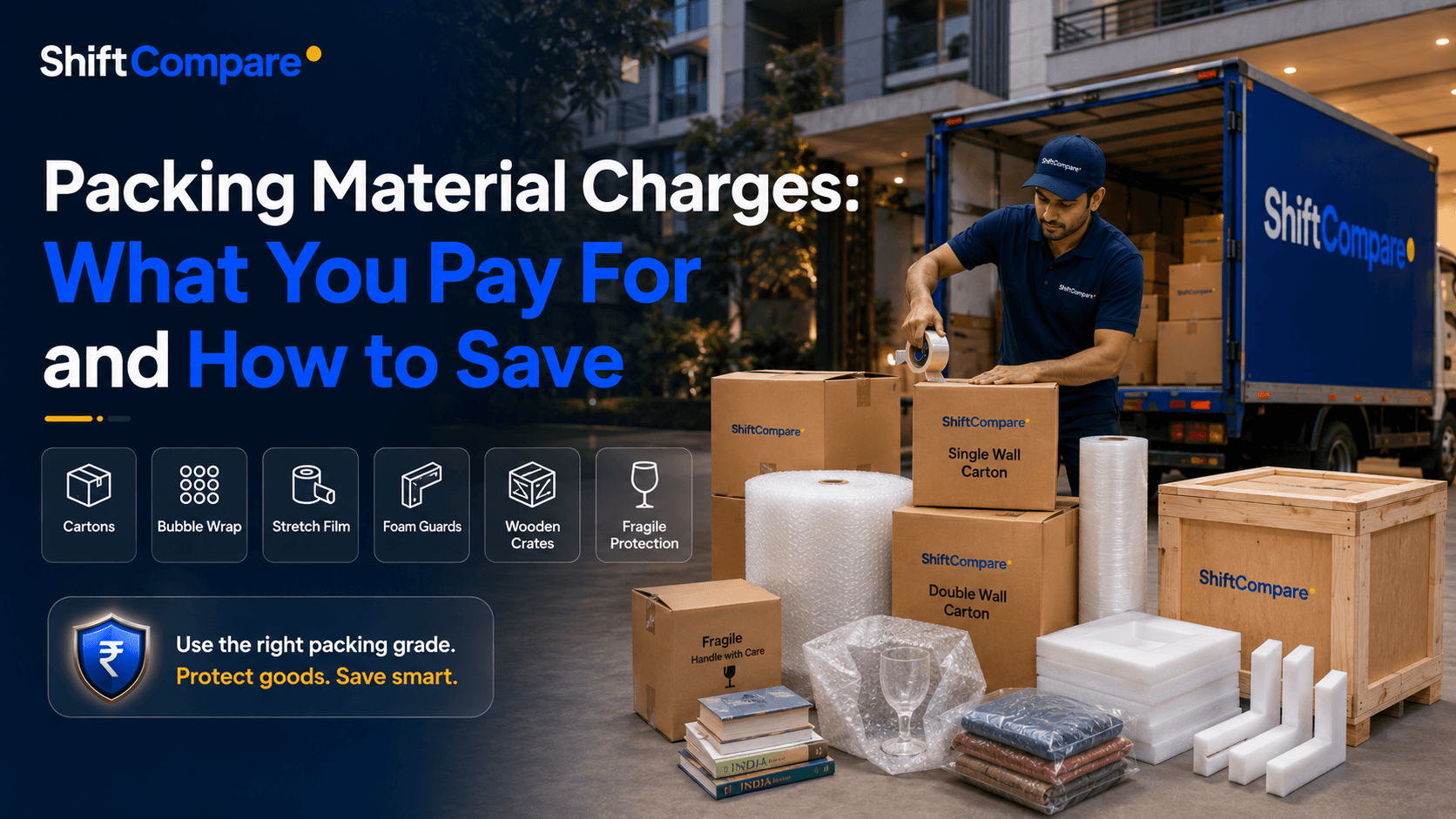
Packing material is the part of a moving bill people most want to argue down, and the part they most regret cutting. It looks like a soft cost, a few cartons and some bubble wrap, easy to trim. Then a poorly wrapped television travels three hundred kilometres on a bumpy highway, and the saving on wrap is wiped out many times over by the cracked screen. I have watched that exact trade play out more than once.
Here I will walk through what packing material charges actually pay for, how to tell a fair charge from a padded one, and where you can genuinely save without gambling with your own goods. For the specific rates in your area, the dedicated packing material charges page carries the numbers, while the focus here is the thinking behind them.
What packing material charges actually pay for
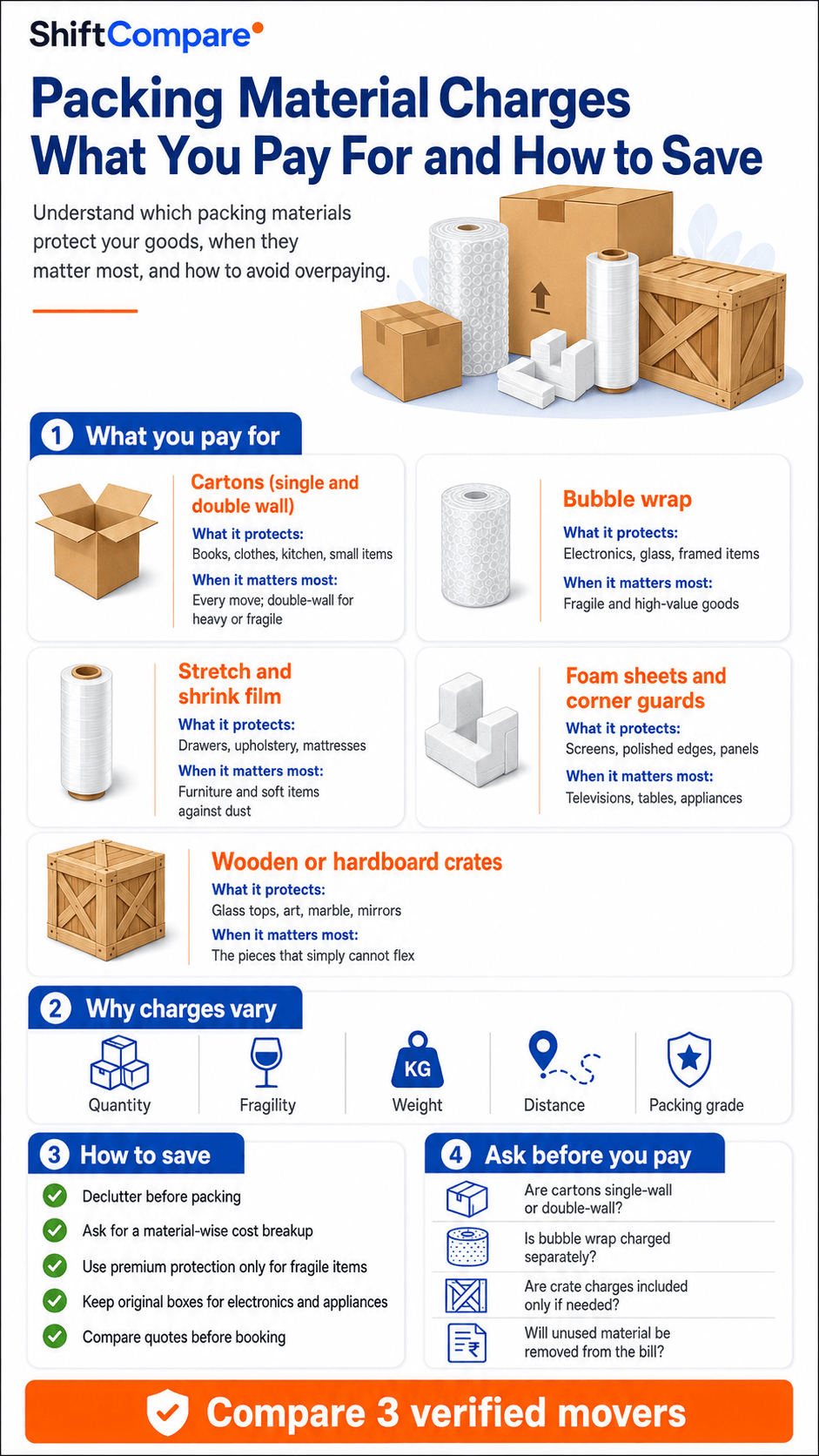
The material line covers the consumables that stand between your belongings and the road: cartons in several sizes, bubble wrap, stretch and shrink film, foam sheets and corner guards, packing tape, and crates for the items that need real protection. None of it is glamorous, and all of it is doing a job. The carton holds the shape, the wrap absorbs the shock, the film keeps drawers and doors shut, the crate takes the impact a glass top cannot.
A fair material charge tells you, at least roughly, what grade and quantity you are buying. A vague figure with no detail is the problem, because it could mean careful fragile packing or it could mean a handful of thin cartons. When you read a quote, the material line should be specific enough to picture, which is exactly the test our guide on how to read a moving quote applies to every line.
The materials, and what each protects
It helps to know what each material is for, because that is how you judge whether a quote has the right mix for your home.
| Material | What it protects | When it matters most |
|---|---|---|
| Cartons (single and double wall) | Books, clothes, kitchen, small items | Every move; double-wall for heavy or fragile |
| Bubble wrap | Electronics, glass, framed items | Fragile and high-value goods |
| Stretch and shrink film | Drawers, upholstery, mattresses | Furniture and soft items against dust |
| Foam sheets and corner guards | Screens, polished edges, panels | Televisions, tables, appliances |
| Wooden or hardboard crates | Glass tops, art, marble, mirrors | The pieces that simply cannot flex |
A 1 BHK of mostly clothes and books needs cartons and tape and not much else. A home with a large television, a glass dining top, and framed art needs the foam, the crates, and the bubble wrap, and the material charge will and should reflect that. The mismatch to watch for is a fragile-heavy home with a suspiciously light material charge.
Quality grades: where cheap material costs you later
Not all cartons are equal. A fresh double-wall carton holds crockery safely; a reused, softened single-wall box from a grocery store collapses under the same load. Bubble wrap comes in thin and thick; one layer of thin wrap on a screen is barely protection. The grade is where a low material charge often hides, because cheaper, weaker, reused material brings the number down and the risk up.
This is why a slightly higher material charge from one mover can be the better deal. If it buys new double-wall cartons for the kitchen and proper foam for the television, it is doing more than a lower charge that buys tired boxes and a single pass of thin wrap. When you compare quotes, compare the grade behind the charge, not just the figure, the same way you would weigh any line on the Gurgaon charges page.
How packing material is usually charged
There are two honest ways a mover bills material. Some itemise it as a separate line, often by quantity, so many cartons, so many rolls of wrap, a crate for the glass top. Others fold it into a full-service house shifting package where packing is included in one price. Both are fine, as long as the scope is written. A package that says full packing included should still tell you that fragile items get crates and the television gets foam, not just leave it to trust.
The dishonest version is the vague middle: a material charge that is neither itemised nor clearly part of a package, just a number floating in the quote. That is the one to question, because it is impossible to compare against another quote and easy to quietly downgrade on packing day. Use the moving calculator to get a sense of the overall range before a mover quotes, so a padded material line stands out.
What a fair material charge looks like
A fair charge passes three tests. It is specific enough that you can picture roughly what you are buying. It matches your actual home, more for a fragile-heavy house, less for a clothes-and-books flat. And it is consistent with the rest of the quote, so a careful full-packing job carries a sensible material cost rather than a token one that hints the packing will be thin.
If a quote claims premium full packing but the material charge is barely there, the two do not add up, and the packing is usually where the corner gets cut. The reverse is also worth a question: a heavy material charge on a light, sturdy home may be padding. The number should make sense for what is actually being wrapped.
DIY versus professional packing material
You can save real money by handling some material yourself, as long as you draw the line in the right place. Sturdy items, clothes, books, and linens can go into cartons you source yourself, and decluttering before the move cuts both the material and the labour, since every carton you do not pack is one you do not pay to fill or carry.
Where DIY stops paying is fragile, electronic, and high-value goods. The right foam, the right crate, and the technique to wrap a screen or a glass top are worth paying a professional for, because the saving on doing it yourself is tiny next to the cost of getting it wrong. The sensible middle path is your own cartons for the easy things and professional material and hands for the fragile ones. Our guide to packing fragile items shows exactly where that line sits.
Where you can genuinely cut material cost
The honest savings are upstream of the quote. Declutter first, so you are not paying to pack and move things you will discard anyway. Source your own sturdy cartons where you can. Use what you already own as packing, suitcases for clothes, blankets and towels as padding around furniture, so you buy less wrap. And pack the non-fragile rooms yourself if you have the time, leaving the crew to focus their material and skill on the kitchen, the electronics, and the breakables.
Each of these trims the material bill without touching the protection on the items that actually need it. Pair the inventory habit from our packers movers inventory list guide with this, and you end up paying for exactly the material your goods need and not a rupee of padding.
Where cutting cost is a false saving
The false savings all look the same: they trade a small, certain cost now for a large, possible cost later. Skipping the crate on a glass top. One thin layer of wrap on a television. A reused weak carton for crockery. No corner guards on a polished table. These shave a little off the material line and quietly raise the odds of a breakage that no small saving will cover.
The material charge is one of the cheapest forms of insurance in a whole move. On the fragile and high-value items, it is almost always worth paying in full. Save on the boxes of books, never on the wrap around the screen.
How the material charge sits with GST, insurance, and your inventory
The material line does not stand alone. It connects to three other parts of the move, and reading them together is what keeps the charge honest. First, GST: packing material in a full-service move is taxed along with the rest, usually at the 18 percent service rate, so the material charge should sit inside a quote that states its GST clearly rather than adding tax quietly later. If a mover offers to drop the material charge for cash with no bill, that is the moment to verify the GST number and walk if it does not check out.
Second, the inventory. The material you pay for is what protects the items on your inventory list, and the two should match. A home with a long list of fragile and high-value pieces needs a material charge that reflects real crating and wrap, because that same declared value is what your insurance pays against if something breaks. Thin packing on a high-value inventory is a mismatch that hurts twice, once in the breakage and again in the weakened claim.
Third, the booking checklist. Before you pay, run the material charge through the same checks as every other line: is it specific, does it match your home, and is the grade named. Add the material question to your booking checklist alongside truck size, labour, and GST, and verify the mover before any advance. A crew confident in its packing will happily put the material grade in writing. One that goes vague the moment you ask is telling you where the corner will be cut, which is exactly the gap our moving quote guide teaches you to close.
Putting it together before you book
Read the material charge the way you would read any line in the quote: specific, matched to your home, and consistent with the packing promised. Save upstream by decluttering and sourcing your own sturdy cartons, and pay in full for professional material on the fragile and high-value items. Then check the figure itself against the dedicated packing material charges page for your area, so you know whether the number you are quoted is fair.
Do that, and the material line stops being the part of the bill you fight and becomes the part you understand. The goal is not to pay the least for packing material, but to pay the right amount for the protection your particular goods actually need, no more on the sturdy things and no less on the fragile ones. Whether your move is across the city or along a route like Gurgaon to Noida, the right material at the right price is what gets your home there in one piece. For the rest of your planning, start with packers and movers in Gurgaon and work outward from there.
Tanuj
Founder, ShiftCompare Technologies Pvt. Ltd.
Tanuj runs ShiftCompare.in and CratoShift.in, having helped 500+ Delhi NCR families compare movers and avoid overcharging. He writes from actual field experience, not press releases.
LinkedInFrequently Asked Questions
What do packing material charges include?
They cover the consumables that protect your goods: cartons of various sizes, bubble wrap, stretch and shrink film, foam sheets, packing tape, and wooden or hardboard crates for fragile and high-value items. A fair charge names the grade and rough quantity rather than hiding it in a single lump figure, so you can see what you are paying for.
How are packing material charges usually billed?
Some movers bill material as a separate line by quantity, others fold it into a full-service package. Either is fine if it is written and specific. The problem is a vague material charge with no detail, because you cannot tell whether it covers proper fragile wrapping or just a few cartons, and you cannot compare two quotes fairly.
Can I provide my own packing material to save money?
Yes, for sturdy items and cartons you can often source your own and reduce the charge. But let professionals handle wrapping for fragile, electronic, and high-value goods, where the right foam, crate, and technique matter more than the saving. Mixing your own cartons with professional fragile packing is a sensible middle path.
Is cheap packing material a false saving?
Often, yes. Thin single-layer wrap on a television, a reused weak carton for crockery, or skipping a crate for a glass top can turn a small saving into a costly breakage. The material charge is one of the cheapest forms of insurance in a move, so cutting it on fragile items usually costs more than it saves.
How much should packing material cost for a 2 BHK?
It varies by city, inventory, and how much fragile packing you need, so treat any single figure as a planning number rather than a fixed rate. The honest answer is to get a quote that names the material grade and quantity for your actual home, and to compare it against the dedicated packing material charges page for your area.